
Half-Pitch Connectors: The 88 and 89 Series
1.27mm Pitch Board-to-Board and Board-to-Cable Connectors
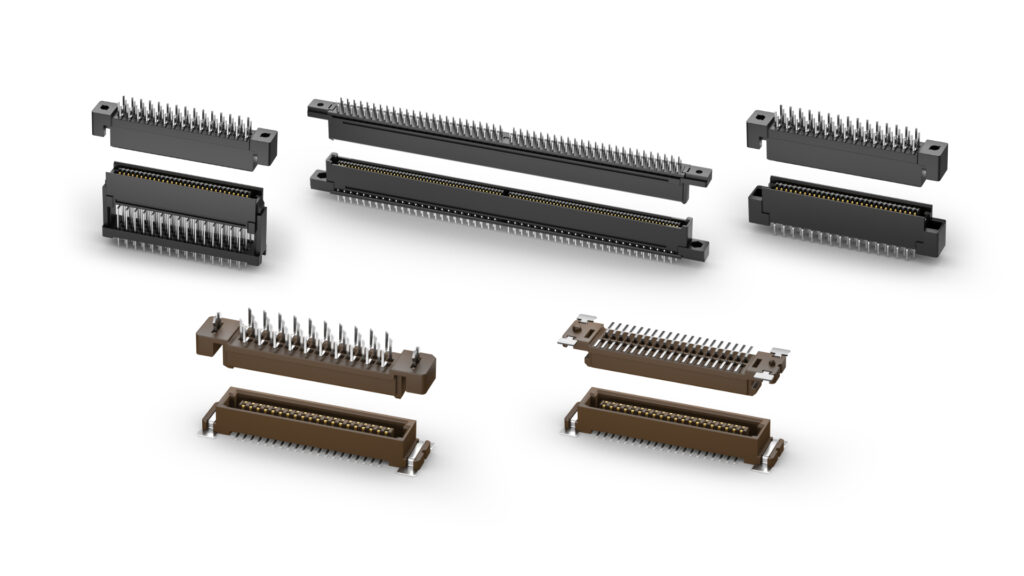
KEL’s half-pitch connectors have been on the market for more than 25 years, and they are still specified into front-line electronic equipment today. Their quality, originality, and forward design haven’t faded. By continuing to respond accurately to the needs of each era, the platform has built a long track record and a wide range of product variations. It remains one of KEL’s long-run products, and it is still growing.
Where They’re Used
The half-pitch platform shows up across industrial and infrastructure equipment: smart meters, rail, industrial robots, ATMs, and semiconductor manufacturing equipment.
The 88 Series
The 88 series uses a contact concept original to KEL: a genderless, vertical two-point contact straight-beam design.
Fully independent two-point contact maintains stable contact pressure at all times, which raises reliability another step. Making the connector genderless (the same shape on both halves) also makes it excellent for volume production.
88 series variations:
• Board-to-board: standard type, multi-pin type, high-stack type
• Interface connector
• Board-to-cable connector
The 89 Series
The 89 series is the low-profile member of the family, built on a different contact concept: KEL’s original compliant single-point contact design.
By building spring into both the plug and receptacle terminals, the contacts follow each other, securing high contact reliability even with a single contact point. The result is roughly half the size of the 88 series. Compare 8825E/8830E at 22.7mm against 8925R/8931E at 11.8mm.
89 series variations:
• Board-to-board: DIP type, SMT type, high-stack type
• Board-to-cable: cable IDC type, cable crimp type
Shared Features Across the Platform
Structure and mechanism, built for handling
• Pin-housing structure with three-sided mold protection. Nothing but the contact surface is exposed, so the contacts resist deformation.
• Mis-insertion prevention. The mold profile differs top to bottom, so the connector cannot be inserted backwards.
Lock mechanism
The original eject lock mechanism allows one-handed operation, a significant step up in handling over the older MIL-standard flat-cable connector lock. Found on the 8825E and 8925E series.
IDC concept and mechanism
The insulation displacement design makes reliable termination simple, with no specialist skill required.
Connection Types
The half-pitch lineup covers stacking, vertical, and horizontal connection, spanning high-stack, flat cable, and interface configurations.
Application Examples
Router, 88 series board-to-board
Part numbers 8801-050-170S-F, 8801-060-170S-F, and 8802-020-170S-F, selected by model. Used for data writing, inspection, and fault repair. Only one half is fitted at product shipment. Adopted on the strength of its insertion and extraction durability in a board-to-board role.
Router, 88 series daisy chain
The 8825R series in a daisy-chain connection. Chosen for the reliability of two-point contact combined with the daisy-chain capability the 8825 allows.
Inverter, 89 series board-to-board
Surrounding components called for a taller connector. The customer was looking for both cost and reliability in a board-to-board part.
Measuring instrument, 89 series board-to-board and board-to-cable
Used between the backboard and daughterboard. Part numbers 8903-020-177MS-A-F and 8931E-020-178L-F. Adopted to downsize from a DIN connector. Lineup flexibility was also a deciding factor, since a harness is used in the evaluation jig.